
 English
  Lietuvių
  Latviešu
  Polski
  Português
  Română
  Slovenčina
  Magyar
  Русский
  Espanol
  България
  Čeština
  Italy
Italy  Croatia
  Greek
Greek 

Several well-developed European countries report high average annual salaries, often exceeding €4,000/month. These great figures are also paired with an exceptional quality of life, reliable public transport transport, and world-class healthcare. This combination often acts as a powerful catalyst for international (often global) talent seeking professional opportunities in these high-wage countries.
As such, in this article, we’ll talk about those European nations where nominal gross salary figures are highest, attracting job seekers with their high standards of living and career prospects. However, it is crucial to remember the correlation between high wages which also often elevates the cost of living index.
Top Counties With The Highest Salaries
The countries below can be considered as financial leaders in terms of the highest-paying countries, significantly exceeding the European median salary. When considering relocation, always factor in the net salary (take-home pay after high taxation rate) and local purchasing power parity (PPP).
1. Luxembourg
If you seek to answer which country pays the highest salary, Luxembourg is the definitive leader.
According to some sources, the average annual salary in the country hovers around €75,919, thanks mostly to its powerful financial sector, and the presence of the European Union Institutions. Finance specialists here can earn anywhere between €3,000 and €8,000 with experience and specialisation.
The high number of international institutions is what drives demand for highly educated and often multilingual experts, which contribute to the high average wage and the high minimum salaries. Naturally, the country also has an exceptional quality of life and excellent services, which all come with a high cost of living.
2. Switzerland
When looking at the average salary per month in Europe per month, Switzerland takes its spot on this list, thanks to its many developed sectors.
Similarly to the case of Luxembourg, Switzerland also has a robust finance and banking sector. Cities like Geneva and Zurich, where the gross monthly wages typically average out at CHF 7,000 (or around €7,500). Life sciences and the pharmaceutical industries are equally strong, particularly in cities like Basel, contributing to a high national average significantly.
What makes Switzerland rank so high on the list? Experts say that the low taxation rate in certain cantons directly translates into higher net salaries, boosting disposable income, even despite the fact that the cost of living can be extremely high.
3. Denmark
The Scandinavian country also offers high pay and pairs it with high social equality. To be more precise, the average monthly salary in Denmark before tax is around €6,000-6,400.
The economy is diversified and driven by highly compensated sectors like pharmaceuticals (Novo Nordisk, etc.) and renewable energy (especially offshore wind). What partly ensures these high wages is the strong collective bargaining system, in which unions and employers collaboratively set wages, and work conditions, contributing to one of the world’s lowest low income inequality.
Still, the high nominal salaries are subject to one of Europe’s highest personal taxation rates. On the other hand, this taxation funds Denmark’s comprehensive welfare system.
4. Belgium
Belgium, especially its capital, acts as a political and administrative hub for Europe. Due to its important role, it’s also one of the highest average-salary countries in the EU, with an average monthly gross pay of €3,800–€4,000.
Among the key factors that drive these figures is the fact that Belgium (Brussels) is the de facto capital of Europe, giving home to major EU institutions (European Commission, Council) and NATO, creating demand for legal, political, and administrative experts in Brussels.
The high standard of living and a statutory minimum wage both contribute to the strong average salary. However, high taxes and social security contributions often reduce the take-home net salary. Still, experts agree that it;s among the best countries to live and work in Europe.

5. The Netherlands
The Netherlands is a major logistics and Tech Hub. The average monthly salaries are also quite inviting for foreign talent, hovering at €3,800–4,200 gross per month across all industries.
The high concentration of multinational corporations and a thriving tech scene, particularly in Amsterdam and Eindhoven are among the main reasons for the high salaries, along with international logistics centers like Rotterdam and political hubs like the Haque.
A major draw for high-skilled non-EU workers is the 30% ruling, a tax incentive that allows employers to pay up to 30% of the gross salary tax-free for five years, significantly increasing the net salary for expatriates. This compensates for the high cost of living.
6. Norway
The average Norwegian salary is around €5,000–5,500 before taxes, making it a rather compelling destination for most workers planning to go abroad. The main salary driver in the country is the petroleum industry (oil and gas), paying premium wages for specialised technical staff and engineers.
Norway also has low income inequality and a strong welfare system, resulting in a high living stanford across the entire workforce, which is highly skilled and educated, further boosting their earning potential.
7. Germany
Europe’s largest country and residential powerhouse, it’s only natural for Germany to make it to this list. With an average salary of around €4,200 gross per month, the country is among the highest salary paying countries in the continent and the EU.
The core sectors are the main salary drivers in the country. Engineering in the automotive industry, a strong IT sector, and a robust manufacturing infrastructure are the most crucial sectors in the country. IT experts, and software engineers may be able to earn an annual average of between €70,000–€100,000+ gross annually.
High salaries, particularly in skilled sectors, attract significant labor-related immigration. However, the progressive tax system means the taxation rate is high, impacting the final net salary.
8. Austria
Austria maintains a stable, high-income economy, with an average monthly gross salary of around €4,500–€4,700, making it an ideal destination for a lot of foreign workers, especially from the Balkans.
Skilled trades are especially welcome, even though managerial roles command the highest salaries. However, despite the high gross salaries and focus on maintaining purchasing power through wage increases, Austria is known for having one of the world’s highest taxation rates on personal income, making the net salary figure lower than expected.
9. Finland
The economy is supported by high-tech industries and a strong public sector, benefiting from the country’s investment in its high quality education system. As such, Finland offers high-quality services and high wages. Couple this with an average monthly gross salary of 3,500 euros per month.
Finland is consistently ranked the World’s Happiest Nation, Finland offers excellent work-life balance and a very low corruption index. However, the total cost of living, particularly housing rent, remains substantial.
10. Ireland
The average monthly gross salary in Ireland is approximately €2,100–€2,200 before deductions, which isn’t particularly the highest on this list, but the country is a global tech hub, which can attract foreign talent, hungry for international recognition.
The massive Foreign Direct Investment (FDI), attracted by the low corporate tax rate, has established Dublin as the European headquarters for major Tech Giants (Google, Meta, Apple). Senior Software Engineers in Dublin can earn upwards of €80,000 to €100,000+ gross.
The concentration of high-paying tech roles skews the average salary upward, though it is slightly lower than others on this list, it boasts significant growth potential.

Focus on High-Demand Skilled Trades
The energy transition and critical infrastructure needs are driving a severe shortage of tradespeople, leading to competitive salaries for certified blue-collar workers.
- Skilled Welders (e.g., Germany): While the national average net annual salary for a general welder in Germany might be around €14,090, highly certified TIG/MIG welders in high-demand industries (like shipbuilding or specialized engineering) can earn significantly more, often grossing over €40,000.
- Example Comparison (2025 Est.):
-
- An average experienced Welder in Germany (Gross €40,385/year) takes home approximately €25,000 net annually.
- A Mid-Level Software Developer in Ireland (Gross €60,000/year) takes home approximately €42,000 net annually.
The income disparity is clear, reflecting the high value placed on white-collar tech expertise. However, the high demand for skilled trades means their salaries are competitive and often offer significant overtime opportunities.
Disclaimer on Salary ExpectationsAt Robin.jobs, we aim to give you the clearest possible picture of what to expect when working abroad. While the average salaries in Germany discussed in this article reflect national data from official sources, the wages listed in our vacancies may vary. However, it’s important to consider the full picture: our job offers typically come with low -cost accommodation. While accommodation isn’t free, it is typically below market rates and arranged by our partner agencies abroad. This ensures candidates have a secure place to stay as they begin settling into a new country and job. These benefits significantly reduce your monthly expenses and often allow you to save more than you could with a higher salary in a big city with high living costs. We focus on legal, reliable, and fair work opportunities, helping you start earning from day one, without the financial burden of high rent, long commutes, or upfront costs. |
Countries With The Highest Salaries in Europe: Critical Considerations
Looking for the country with the highest salary is one thing, but what you can actually do with said salary is another thing. Robin can summarize some of the critical factors that have an influence on how much you can save during your time working in another country:
As you will see, earning potential isn’t just about net and gross salaries. There are other important factors that will ultimately determine how well off one is with the salary they are earning in a particular country.
Minimum Salary Abroad
It’s only normal for us at Robin to focus most on the average and minimal salaries in the countries we work with the most (Germany, The Netherlands, and Belgium). The comparison of these states will give you a better insight on your possible future income. Let’s take a look together!
The minimum salaries abroad pretty much look like the following:
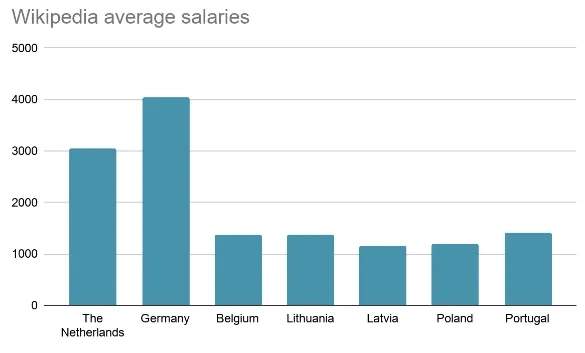
As you can see, the countries show quite different results looking at the average salaries compared to the minimum wage. There might be several explanations for that:
- The Dutch have a progressive tax system.
- The more you earn, the more taxes you pay.
- The less you make, the fewer taxes you pay.
Germany might pay higher salaries for higher-skilled jobs, so the average wage is higher than in the Netherlands.Each country uses its own methods in calculating the average salaries. For example, in the Netherlands, the very rich’ wages are not included in the average wages. These don’t show the real situation of the average working population. In Germany, all wages are incorporated into the calculation.
Although the average salary says something for you when you go to work abroad, you need to be realistic about how the job you plan to get will be paid. The average salary might give you an idea when planning a career abroad to see what perspectives there are for you. Still, you need to be realistic. Most people who go to work with Robin’s help go to work in logistics or production, which is usually paid slightly higher than the minimum wage.
Cost of living
Another important factor is the monthly expenses you have to address. These can add up quite fast and are probably the most crucial aspect of determining the real value of any salary.
Accommodation Abroad
Although salary will decide how much you will earn each month, you need to deduct your expected expenses of living abroad to know your savings.
Most costs of people who go to live temporarily abroad with Robin’s help are related to groceries and accommodation.
As Robin is working with many different agencies in the Netherlands, Belgium, and Germany, we can compare how much these agencies charge per country on average in your living place. In all three countries, we see significant regional differences looking at the costs of accommodation.
Munich f.e. is much more expensive to live in than Berlin, and Eindhoven is much more costly than Leeuwarden in the Netherlands. Here we see that most of the jobs offered in all these three countries are in the economically most developed regions. The regions where the businesses outgrow the amount of labour that is available in the area. The downside of this is that these regions have, in general, the most significant shortage of accommodation, as a result of this the price for housing is higher.
Expect to pay in the Netherlands around 100 Euro for a bed in a double room per week,
including utilities. In Belgium (Antwerp) you should expect to pay 110 Euro and in Germany around 90 Euros for the same level of accommodation.
Keep in mind, accommodation will be provided for you in the Netherlands as long as you stay working through the agency. In Belgium and Germany, accommodation is provided as a temporary solution to your accommodation problems. The accommodation is usually only available for the first months that you are employed. After the early months, the agency expects you to organize the accommodation yourself, just like the locals. The agency will help you find accommodation if that would be needed.
Unemployment Rate
The last factor on which your salary might depend is the unemployment rate. The lower the unemployment rate, the more companies are willing to add on top of the minimum wage to keep their staff on board.
Take The First Steps With Robin to The Highest Salaries In Europe
While there are ten high-salary countries in this list, Robin mainly works with companies from Germany, The Netherlands, and Belgium. Fortunately, these three states are among the most competitive on this list, making them an ideal choice for every blue-collar candidate, who wants to find a new job abroad.
If you are up to a new adventure, feel free to register on our site and reach out to our recruiters.