
 English
  Lietuvių
  Latviešu
  Polski
  Português
  Română
  Slovenčina
  Magyar
  Русский
  Espanol
  България
  Čeština
  Italy
Italy  Croatia
  Greek
Greek 

Did you know that the Netherlands is among the ten highest-paying countries in the world?
With its central European location, it’s a thriving economic centre and one of the top European working destinations. People from all around the world choose this country in search of great career opportunities.
The Netherlands is a leader in various industries (healthcare, information technologies, production, technical, logistics, and agriculture), providing diverse job opportunities. With that in mind, understandably, the average salary in the Netherlands is higher; however, these ranges fluctuate significantly for every profession.
This article explores the current average salary in the Netherlands in 2026. Examining average wages and tax brackets will shed light on the Dutch financial landscape, empowering you to make informed career and financial decisions.
Key Takeaways
- The Netherlands is among the top ten highest-paying countries globally and has the highest minimum wage compared to other European countries.
- The average gross salary in the Netherlands is €48,834 per year, or around €3,748 per month. However, keep in mind that some individuals will earn minimum wage for the same position according to their education and experience. The minimum wage for employees aged 21 and older, for 40 working hours is around €14.71 gross.
- Be aware of the difference between the gross and net income amounts. After all the tax deductions are subtracted, an average monthly net salary is around €2,600 per month, or €36,600 per year.
What’s the Average Salary in the Netherlands?
Typically, the average gross salary is around €48,834 per year, or around €3,748 per month, according to the Dutch Central Planning Bureau. However, after taxes, social security contributions, and other deductions, the average monthly net salary is closer to €3,050, or €35,093 for an average yearly salary.
Some individuals may receive significantly higher compensation for the same position as you due to their professional experience. On the other hand, some might earn lower wages (considerably below average salaries) due to factors such as age, lower educational levels, gender pay gap, lack of experience, or company size.
However, the average Dutch employee is still ranked among the higher-earning European workers.
Average Salaries in the Netherlands by Profession
Finding the exact source for your list, the data appears to align with the salary benchmarks provided by Robin.jobs (your partner platform) and ERI (Economic Research Institute).
Based on the latest CPB (Netherlands Bureau for Economic Policy Analysis) reports from March 2026, nominal wages in the Netherlands have seen a steady increase. A significant factor is the rise of the statutory minimum wage to €14.71 per hour as of January 1, 2026, which has pushed the floor for entry-level roles like cleaners, waiters, and warehouse workers.
| Profession | 2026 Average Salary (Gross/Mo) | Notes |
| Factory Worker | €2,775 | Adjusted for 2026 minimum wage floors. |
| Assembly Line Worker | €3,795 | Increased demand in tech-heavy manufacturing. |
| Pickers (Food Industry) | €3,095 | Reflects shift premiums and 2026 inflation. |
| CNC Operator | €3,875 | High demand for precision manufacturing. |
| Welder | €4,430 | Specialised “stamps” (TIG/MIG) fetch higher. |
| Carpenter | €3,650* | Correction: The previous €1,980 was below legal minimums for 2026. |
| Construction Worker | €4,135 | Reflects the 2026 housing project boom. |
| Civil Engineer | €4,790 | |
| Construction Project Mgr | €7,925 | High-level management premiums. |
| Plumber | €4,875 | High demand due to energy transition (heat pumps). |
| Electrician | €5,200 | Critical for 2026 green energy infrastructure. |
| Mechanical Engineer | €4,720 | |
| Nurse | €4,030 | Reflects 2025/2026 collective labor agreement (CAO) hikes. |
| Laboratory Technician | €3,775 | |
| Receptionist | €2,550* | Correction: Updated to meet 2026 full-time minimum wage. |
| Cashier | €2,550* | Correction: Updated to meet 2026 full-time minimum wage. |
| Waiter | €2,450* | Reflects standard full-time hours + mandatory tips/service. |
| Cook | €2,850* | Specialized Horeca skills are in high demand. |
| Cleaner | €2,550* | Standardized to 2026 minimum hourly rates. |
| Office Administrator | €2,650 | |
| Truck Driver | €4,045* | Major 2026 adjustment for C-license scarcity. |
| Reach Truck Driver | €2,850* | Warehouse logistics premiums. |
| Car Mechanic | €3,150 | Higher rates for EV-certified mechanics. |
Average Salary in the Netherlands by City
As of 2026, Eindhoven has the highest average income in the Netherlands, followed by Amsterdam. This is partly due to their roles as key economic hubs and centres for startups. These cities thrive in various industries, including finance, technology, creative arts, and tourism, all of which contribute significantly to their economic strength.
| City | Average Monthly Salary (Gross) | Key Economic Drivers in 2026 |
| Eindhoven | €5,750 | Brainport hub; dominated by high-tech (ASML, Philips) and R&D. |
| The Hague | €4,855 | Government center, international NGOs, and legal headquarters. |
| Amsterdam | €4,815 | Financial services, tech startups, and the creative sector. |
| Rotterdam | €4,545 | Logistics, maritime engineering, and Europe’s largest port. |
| Utrecht | €4,450 | Central logistics hub, education, and healthcare headquarters. |
| Bussum | €4,335 | High-income residential area for commuters to Amsterdam/Utrecht. |
| Leiden | €4,035 | Life sciences, biotechnology, and academic research. |
| Breda | €3,815 | Logistics and cross-border trade between NL and Belgium. |
| Coevorden | €3,805 | Industrial and manufacturing hub in the northern region. |
| Almere | €3,690 | Rapidly growing residential and service-oriented hub. |
| Groningen | €3,690 | Education, energy (hydrogen transition), and ICT. |
| Tilburg | €3,350 | Manufacturing and textile-turned-logistics center. |
What’s the Net Salary After Tax in the Netherlands?


If you are living in a well-organised country such as the Netherlands, you’ll be obligated to pay a wide variety of taxes. Naturally, with higher salaries, a higher income tax comes as well. When it comes to income tax, as a Dutch resident, you will be taxed at 35.75% or 49.50%.
The exact amount depends on your annual salary. Residents that make more than €78,426 annually will pay a higher income tax rate.
What is Incorporated Into Your Dutch Salary?
Dutch salaries include an abundance of benefits. Let’s start with the most important benefit: sick leave.
In the Netherlands, the Dutch Government implemented a law that obliges your employer to pay you 70% of your wages while you are on sick leave. If you are sick for a longer period, there is no risk of losing your position. By law, your employer must pay your sick leave for up to 104 weeks during your employment contract.
Some companies offer a 13th-month salary. You will receive one extra salary before the holiday period in November or December. In most cases, that bonus equals around 8% of your salary.
Besides the 13-month salary, many employers offer a holiday allowance (vakantiegeld) in the amount of at least 8% of your annual earnings, which is close to your average monthly salary. This allowance is paid in May or June.
When you are recruited from abroad, there is a great chance that you will receive remuneration packages, including coverage for initial housing and moving costs, while some Dutch employers go further and even offer financial support for international schools for your children.
The Netherlands is famous for its 30% rule for expats. This rule gives you the possibility of getting 30% less income tax on your salary for the first 20 months, resulting in a higher net income.
Dutch Payslip Explained
As a Dutch employee, with each month’s salary, you’ll receive a payslip (loonstrook) from your employer. This document includes information about your salary, how your wage was calculated, and the amount that has been subtracted. It can be very hard to understand a Dutch payslip as a foreigner, so here is a basic breakdown:
- Periode – the exact time frame of your salary (month or week)
- Personeelsnummer – your number
- Salaris / uurloon / periode / maand / year – the gross salary pre-tax (per hour /month /period /year)
- Bijz. tarief / heffingskorting (ja) – the special tax rate for bonuses and general tax credit (indicated by yes)
- Verzekerd voor WW, WiA, ZW, Zvw – contribute to the social security you are covered for
- Datum in dienst – the date you signed your employment contract
- Burgerservicenummer (BSN) – your Dutch social security number
- Functieomschrijving – your job description or job title
- Normale gewerkt uren – the number of your working hours
- Brutoloon, Belastbaar loon / Loon / Loon voor de loonheffing – taxable wage or gross salary
- Pensioengevend loon – salary for pension purposes
- Loonheffing – the amount that was deducted as prepaid tax and social security contributions
- Sociale verzekeringen (SV) – social security contributions
- Reiskostenvergoeding – transport compensation
- Nettoloon – the net salary after tax, deductions, and refunds; this is the amount you’ll receive in your bank account.
- Cumulatief – cumulated salary over the year
- Opgebouwd vakantiegeld – the (accumulated) holiday allowance or leave in hours
What’s the Minimum Wage in the Netherlands?


The minimal wage is a legally mandated minimum amount that an employee must be paid. Twice a year, the Dutch government updates the minimum wage on January 1st and July 1st. This adjustment reflects fluctuations in basic salary as well as living costs. You should note that the Netherlands has the highest minimum wage compared to other European countries.
As of January 1, 2026, the Netherlands has fully transitioned to a statutory hourly minimum wage for all employees. This change eliminates the old “fixed monthly” minimum wage to ensure that every worker is paid the same hourly rate, regardless of whether their sector’s full-time workweek is 36, 38, or 40 hours.
For workers aged 21 and over, the standard minimum hourly wage is €14.71 gross.
While the hourly rate is fixed, the total monthly amount varies based on the number of hours worked. In sectors where a Collective Labour Agreement (CAO) defines a full-time week as 36 or 38 hours, the monthly total will be lower than a 40-hour week, but the hourly compensation remains legally consistent at the €14.71 floor.
For workers under the age of 21, the minimum youth wage applies. These rates are a percentage of the adult hourly wage and increase annually on the worker’s birthday until they reach the age of 21.
Below are the mandatory hourly rates and the resulting monthly gross totals for a standard 40-hour workweek in 2026:
| Age | Hourly Rate (Gross) | Monthly Total (40 hrs/week) |
| 15 years | €4.41 | €764.92 |
| 16 years | €5.08 | €881.01 |
| 17 years | €5.81 | €1,007.64 |
| 18 years | €7.36 | €1,276.53 |
| 19 years | €8.83 | €1,531.04 |
| 20 years | €11.77 | €2,040.58 |
| 21 years and over | €14.71 | €2,549.73 |
Average vs. Median Salary – what’s more relevant?
Understanding income distribution involves two key measures: average and median. The average salary, also known as the mean, simply adds up everyone’s income and divides that amount by the total number of people. It’s easy to calculate, but high earners can mix things up and paint a picture that is not real.
The median income in the Netherlands, on the other hand, provides a more representative picture. By arranging incomes from lowest to highest and finding the middle value, the median is less affected by extreme cases. As a result, the median income is typically lower than the average.
The median salary in the Netherlands varies in the different sectors and is considered more relevant than the average salary, particularly in industries prone to a significant gap between the salaries of senior executives and the standard worker.
Calculating Your Dutch Salary: Understanding the Difference Between the Gross and Net Income
Whether you earn a monthly salary or are paid hourly wages, you’ll notice phrases like gross and net salary on your paycheck. It is crucial to know the differences between brutto and net income to be able to create an accurate monthly or yearly budget and make sound financial decisions.
Gross salary (brutto) is the total amount you’ll receive before any taxes and deductions are accounted for. This is the highest number you will see on your pay statement and it is based on your previously agreed salary or hourly wage.
Net salary is the amount of money that you’ll receive in your bank account once all the taxes and deductions have been subtracted from your gross salary. You will easily recognise the Dutch net salary amount on your paycheck statement since it appears in a larger, bolder font than your gross salary.
Let’s break down a sample scenario for 2026. Earning €20 per hour for a 30-hour workweek means your weekly gross salary is €600, or €31,200 annually. While the base tax rate for this bracket is 35.75%, your actual “effective” tax rate will be much lower due to Dutch tax credits. After applying the 2026 General Tax Credit and Labour Tax Credit, your net income will be approximately €27,250 per year (around €2,270 per month). Remember, this is the take-home amount before factoring in personal work-related expenses like commuting or private insurance.
It’s very important to discuss your net salary in the Netherlands with your potential employer so you’ll be certain of how much actual money you will receive for your services.
Compensation Costs for Employees
The costs of compensating employees in the Netherlands go way beyond the gross salaries and include a wide variety of elements that form an employee’s remuneration package.
It is crucial for businesses operating in the Dutch job market to understand these costs, as they greatly impact overall financial planning. The exact figures for these costs vary based on industry, age, position, experience, and collective labour agreements. Regardless, the average cost on top of the gross salary ranges between 20% and 35%.
These elements are included in the employee remuneration package:
- Direct wages – This is your gross wage, which includes all bonuses or allowances that are regularly paid out.
- Social Security contributions – Employers are required to pay these contributions to fund a variety of benefits for you, such as health insurance, unemployment insurance, and pensions.
- Insurance contributions – Specific industries and job positions require specific insurance contributions, like liability or accident insurance.
- Pension contributions – Some employers offer you the option of private pension schemes besides the basic state pension (AOW).
- Payroll taxes – These payroll taxes help finance public services and social security funds.
- Leave entitlements – This considers all the paid leave entitlements, such as sick leave, maternity/paternity leave, and vacation. They are part of the statutory leave benefits in the Netherlands.
- Other labour costs – These costs usually include expenses related to training, workshops, and investing in employee’s professional development. This also includes employee benefits like a company car, mobile phone, gym membership, childcare support, and meal vouchers.
To you, as a potential hire, these comprehensive remuneration packages can tell a lot about the company’s care for its employees. The more diverse the compensation package, the more attractive and reliable the company is.
Which Factors Impact the Average Salary in the Netherlands?

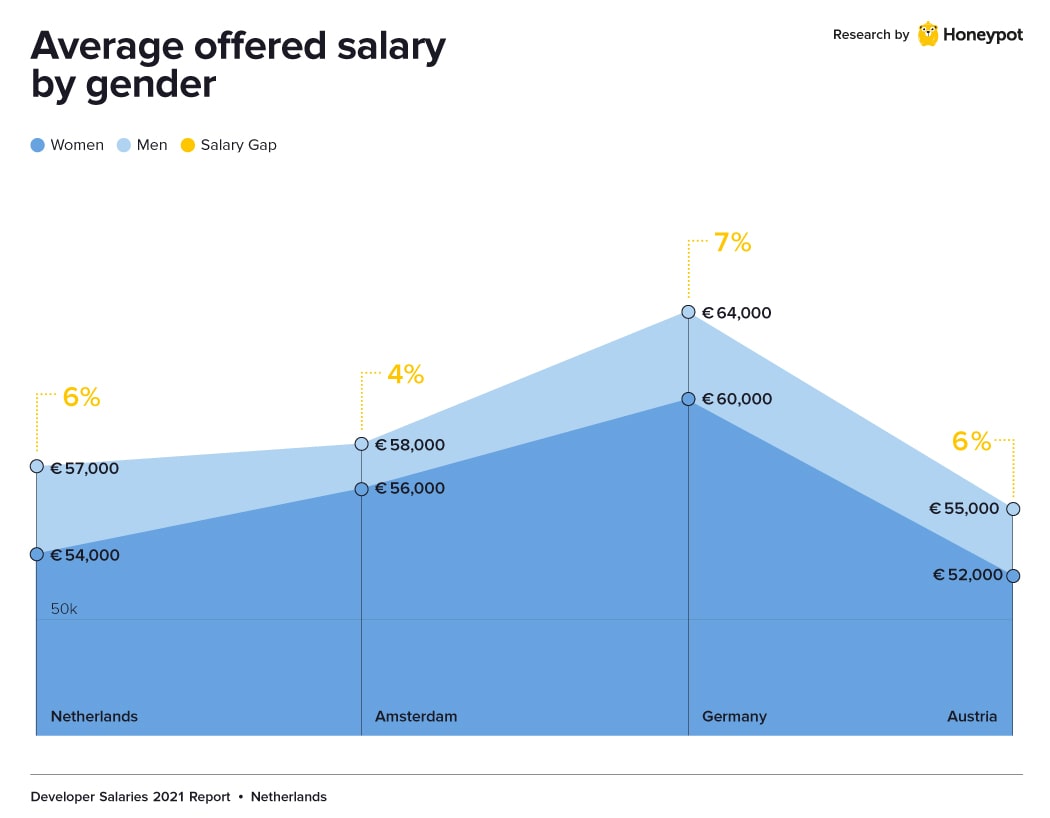
A variety of factors influence salaries in the Netherlands. These factors will define how much you can earn. Here is a list of the main factors that influence the average salary:
- Educational level – People with higher education qualifications (bachelor’s, master’s, or doctoral degrees) usually earn higher wages due to the knowledge and skills they provide.
- Professional experience – Individuals with several years of relevant experience have a higher chance of getting hired and earning significantly above the average income. This is because they add more value to the company with their knowledge and practical skills in the specific industry.
- Industry – The average wage in the Netherlands varies significantly depending on the industry. Some sectors, such as engineering, medicine, information technology, or finance, offer higher wages. On the other hand, hospitality and retail offer lower wages due to economic trends.
- Company size – Larger corporations are capable of offering higher salaries in comparison with startups and smaller companies.
- Location – Your location in the Netherlands plays a prominent role in your Dutch salary. In urban areas like Amsterdam, many different international companies operate and offer higher average salaries compared to smaller cities and rural areas.
- Contractual arrangements – The type of contract (permanent, temporary, freelance) generally affects earnings. Permanent contracts are more stable and offer higher wages than temporary or freelance contracts.
Comparison With Other European Countries

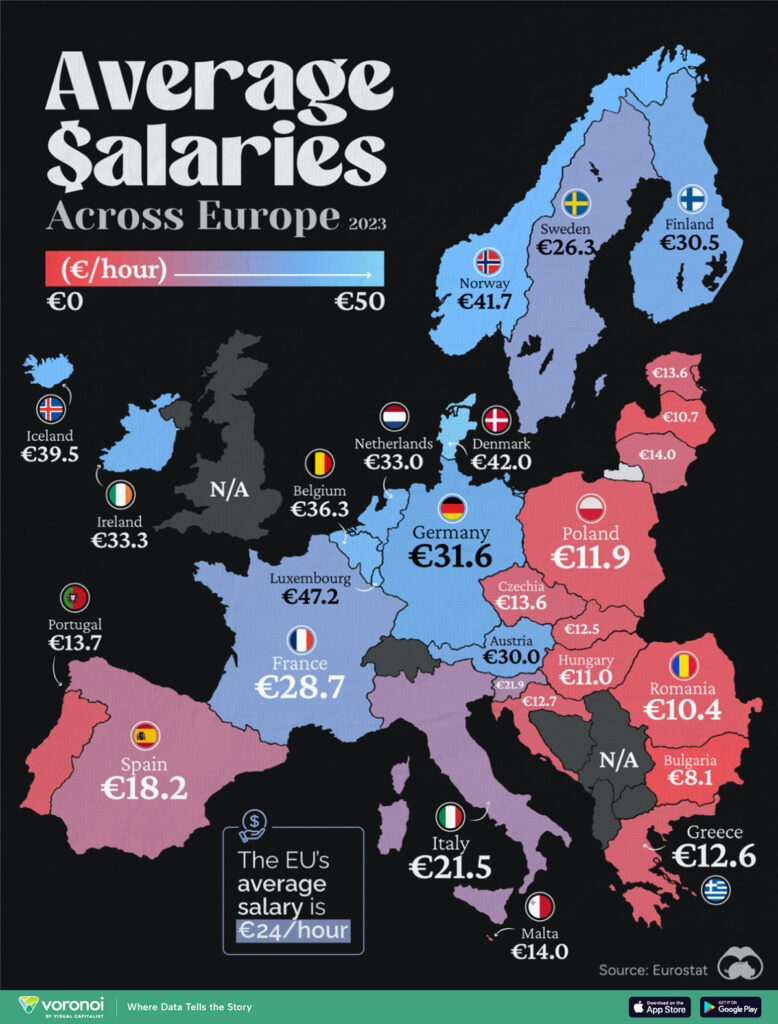
Overall, the Netherlands ranks pretty high when it comes to average salary and minimum wage compared to many European countries. The country’s stable and prosperous economic standing is the main reason why many foreign workers and expats choose to move there.
| Country | Average Salary (Gross/Mo) | 2026 Market Insight |
| Switzerland | €7,450 | ~7,015 CHF. Remains the highest in Europe. |
| Denmark | €6,030 | ~45,000 DKK. Driven by strong pharma and tech sectors. |
| Germany | €4,450 | Reflects significant industrial wage corrections. |
| Belgium | €4,050 | Statbel reports show a push over the €4k mark this year. |
| Netherlands | €3,800 | Now standardized by the €14.71 hourly minimum law. |
| France | €3,602 | Based on latest INSEE and Expatica 2026 reports. |
| Sweden | €4,120 | ~47,000 SEK. Significant nominal growth in SEK. |
| United Kingdom | €3,560 | ~£2,965. Median earnings grew by 4.1% this year. |
| Spain | €2,300 | A slight correction from your previous estimate to reflect actual median data. |
| Portugal | €1,620 | A healthy rise from €1,463 as the economy diversifies. |
While Switzerland and Denmark show the highest gross figures, it’s always worth remembering that the cost of living and tax structures in the Netherlands often result in higher “disposable” income for blue-collar professionals compared to the Nordic countries.

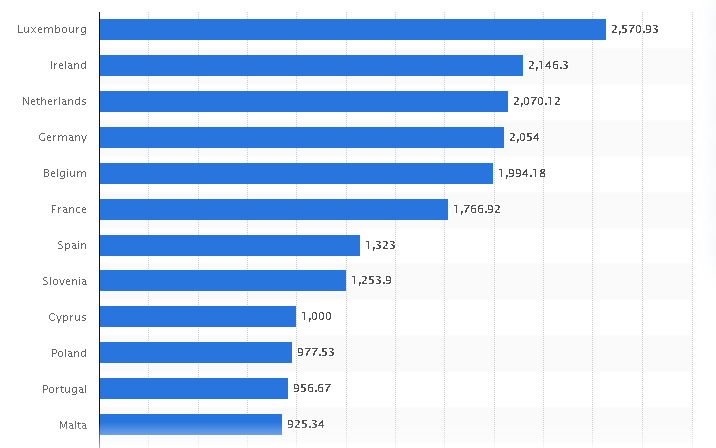
Beyond the gross salary, the Netherlands offers a comprehensive welfare state with extensive social services, providing additional value to Dutch residents.
Moving to the Netherlands Shouldn’t Be Just For the Salary
Choosing a new country can make or break your professional journey. Luckily, the Netherlands could be a perfect fit for you since it has progressive policies, a booming economy, and an amazing quality of life.
This is the main reason why it is a top choice for international professionals seeking both working opportunities and a fulfilling lifestyle. The Netherlands is a magnet for multinational corporations like Nike, Adidas, Tesla, and IKEA to Netflix.
These companies provide a minimum wage above average and an opportunity to experience work in different sectors like technology, finance, logistics, and the creative arts.


Many industries in the Netherlands operate 24/7, so you can earn more by working outside regular hours. This way, you become eligible for shift allowances, which can substantially increase your earnings.
For a foreign worker, a high level of English proficiency is a big plus since many companies conduct their business in English. Don’t forget the presence of a world-class educational and healthcare system that prioritises the education and well-being of all residents.
If professional development and an improved life standard are your ultimate goals, then there is only one thing to do: explore vacancies in the Netherlands and see what this country has to offer you.
Frequently Asked Questions About Salaries in the Netherlands
What Is a Good Salary In the Netherlands?
A gross work income between €3,500 and €4,600 per month is considered good in the Netherlands. Annually, including the 8% holiday allowance, this amounts to between €45,360 and €59,616. This translates to a net salary of between €2,910 and €3,565 per month after 2026 taxes and credits. If you consider a monthly cost of living of around €2,450, this salary allows you to comfortably cover your basic expenses and still save some money.
How Will Inflation Impact Dutch Salaries in 2026?
While the cost of living saw a historic surge in 2022, the transition to a mandatory hourly minimum wage in 2024 and 2025 has significantly reshaped the 2026 landscape. For 2026, the Central Planning Bureau (CPB) forecasts an average purchasing power rise of 2.7%, with a net income increase of 3.8% across most sectors. Those earning the statutory minimum of €14.71 per hour will experience the most substantial impact; due to the structural shift in how full-time hours are calculated, 40-hour workers are effectively seeing a double-digit percentage boost in their monthly gross compared to previous years.
What Is the Average Salary in the Netherlands by Age?
The average annual salary for professionals in the 25 to 45 age range is approximately €55,800. In contrast, earnings typically peak for the older generation; individuals aged 45 to 65 earn an average annual income of €72,100, reflecting the value of long-term experience in the Dutch labor market.
The Netherlands Labour Authority (NLA) permits 15-year-olds to perform light, non-industrial work after school and during holidays. Strict regulations exclude them from working in factories, operating machinery, or delivering meals by bike. As of January 1, 2026, these young workers earn a statutory minimum youth wage of €4.41 per hour, ensuring they are fairly compensated for their contributions.